Jaisalmer vs Jodhpur Which Is Better?
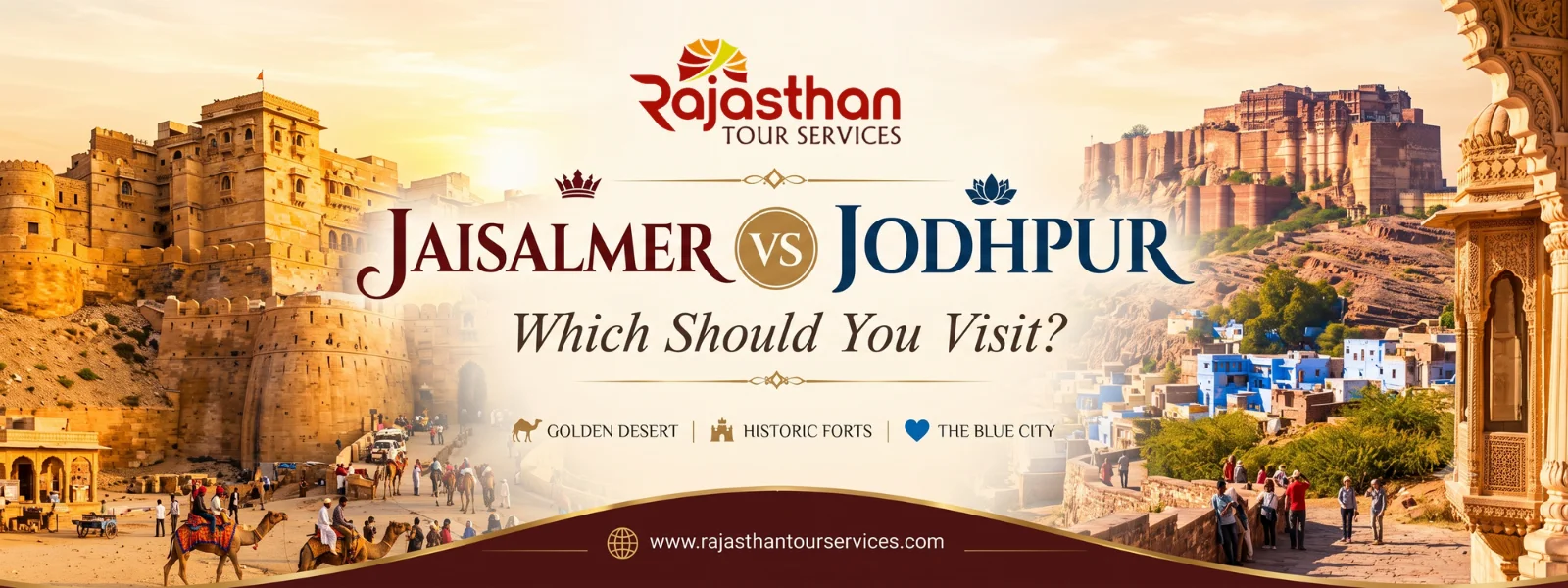
Jaisalmer vs Jodhpur comes down to the kind of Rajasthan experience you want. Jaisalmer is better if you want a small golden sandstone town on the edge of the Thar Desert, with camel treks, dune camps, and some of the clearest night skies you’ll see in India. Jodhpur is better if you want a big, working city with a huge fort, blue-washed lanes, great street food, and easy flights from Delhi. If it’s your first trip to Rajasthan and you’ve got four days or less, go with Jodhpur. If you’ve got a week, do both. They’re about 285 km apart, roughly 5 to 6 hours by road or train, and they feel like two different countries.
That’s the quick version. Below is the detail we share with Aussie travelers at rajasthantourservices.com when they ask us which one to pick.
Table of Contents
Jaisalmer Vs Jodhpur At A Glance
| Category | Jodhpur | Jaisalmer |
|---|---|---|
| Nickname | The Blue City | The Golden City |
| Founded | 1459, by Rao Jodha | 1156, by Rawal Jaisal |
| Size | Over 1 million people (2011 census) | Roughly 65,000 people (2011 census) |
| Vibe | Busy, colourful, very local | Small, slow, desert edge |
| Headline sight | Mehrangarh Fort | Jaisalmer Fort (Sonar Qila) |
| Best for | First-timers, food lovers, photographers | Desert fans, stargazers, couples |
| Ideal stay | 2 nights | 2 nights |
| Getting there | Airport with flights from Delhi, major rail hub | Small airport with limited flights, otherwise a long road or rail trip |
| UNESCO | Not itself listed | Jaisalmer Fort is part of the Hill Forts of Rajasthan (listed 2013) |
What Jodhpur Is Really Like
Jodhpur caught us off guard. We pencilled it in as a stopover and ended up wishing we’d booked another night. It’s a proper city, with traffic, noise and markets that don’t care whether you’re a tourist or not, and that’s a big part of the charm.
Mehrangarh Fort is the reason most people come. It sits on a rocky hill roughly 120 metres above the city, and the walls are so massive they look like they grew out of the rock. Get the audio guide. The museum inside has royal palanquins, howdahs, weapons and miniature paintings, and the ramparts give you the view everyone photographs: a sea of blue houses spreading out below. If you like a bit of adrenaline, there’s a zipline circuit that runs around the fort walls.
The blue colour is traditionally linked to Brahmin households, and many locals say it helps keep the houses cooler. Wander the lanes of Brahmapuri below the fort early in the morning, and you’ll have them mostly to yourself.
Other places worth your time:
- Jaswant Thada. A white marble cenotaph built in 1899 in memory of Maharaja Jaswant Singh II. It’s calm, pretty, and quick to visit.
- Umaid Bhawan Palace. Finished in 1943, it’s partly a luxury hotel, partly the royal family’s home and partly a museum. Even if you’re not staying, the museum is worth a look.
- Clock Tower and Sardar Market. Spices, textiles, handicrafts, and the best people-watching in town.
Food is where Jodhpur beats Jaisalmer. Start the morning with a mirchi bada (a chilli fritter) or a pyaaz kachori. Finish the day with a makhaniya lassi, the thick saffron-and-cream version that’s a local legend near the Clock Tower. Jodhpur’s sweet shops are good too, especially for mawa kachori.
The downsides: it’s hot from April to June (often above 40°C), the Clock Tower area gets crowded, and you’ll meet the odd person offering to show you “the best view” for a fee. Politely decline and carry on.
What Jaisalmer Is Really Like
Jaisalmer feels like a film set that people still live in. Jaisalmer Fort, also called Sonar Qila or the Golden Fort, was built in 1156 and glows honey-gold as the sun goes down. It’s a living fort, with homes, shops, guesthouses and a cluster of beautiful old Jain temples inside the walls. Because the fort’s old drainage struggles with modern water use, conservationists have raised concerns about damage to its foundations, so many travellers now choose a hotel outside the walls and visit during the day.
The town itself is easy to explore on foot. Patwon Ki Haveli, Nathmal Ki Haveli and Salim Singh Ki Haveli are the big three for intricate carved sandstone. Gadisar Lake, a rainwater reservoir dating back to the 14th century, is peaceful early in the day. At Bada Bagh, a short ride out of town, the royal cenotaphs look their best in late-afternoon light. About 18 km away, the abandoned village of Kuldhara is an atmospheric stop on the way to the dunes.
The desert is the real drawcard. The Sam Sand Dunes are about 40 km from town and the Khuri dunes about 45 km. Sam is the better known and gets busy around sunset. Khuri is quieter and, in our experience, a better choice if you want the stillness. A camel ride at sunset, dinner by a fire with a local folk musician, and a night under a sky full of stars is the experience people remember. If you’ve ever done a night out near Uluru or Broken Hill, the silence will feel familiar, just with a camel instead of a swag.
The downsides: Jaisalmer is remote, flights are limited, and the quality of dune camps varies a lot. Some at Sam run loud music and jeep rides until late. Ask exactly what’s included, whether the camp has a proper bathroom, and how the camels are treated before you book. Winter nights are cold too, sometimes dropping to low single digits in December and January, which surprises a lot of Aussies. In May and June the heat can push well past 45°C.
Which Is Better For You?
- First trip to India: Jodhpur. It’s easier to reach and has a bigger spread of things to do.
- Couples and honeymooners: Jaisalmer for the desert, Jodhpur for palace stays. Honestly, both work.
- Foodies: Jodhpur, by a fair margin.
- Short on time: Jodhpur.
- Want something quieter: Jaisalmer, ideally staying out near Khuri.
Ready to Plan Your Rajasthan Trip?
Get a free, customised itinerary from our local travel experts — no obligation, no spam. Just tell us your dates and preferences.
Best Time To Visit
October to March is the sweet spot for both. Days are warm and dry, and evenings cool down. Pack layers for Jaisalmer in particular, because desert nights get properly chilly. February is a popular month because of the Jaisalmer Desert Festival, which features folk music, turban-tying contests and camel events, though accommodation books out early. Dates change from year to year, so check before you plan around it.
Summer is a hard slog in both cities. The monsoon is light in Jaisalmer and moderate in Jodhpur, so those months are quieter and cheaper, but sticky.
Getting There From Australia
Most Aussies fly into Delhi. Direct flights run from Sydney and Melbourne, and there are one-stop options through Singapore, Kuala Lumpur, Bangkok and the Gulf hubs. Expect around 11 to 13 hours in the air on a direct flight. India is about 4.5 hours behind Australian Eastern Standard Time, or 5.5 hours during daylight saving, so jet lag is mild.
From Delhi, Jodhpur is about a 1-hour 20-minute flight, or an overnight train if you prefer. Jaisalmer has a small airport, but flights are limited, so most visitors reach it overland from Jodhpur. Trains and drivers both do the run in about 5 to 6 hours. One thing you’ll like as an Australian is that India drives on the left. The rules are more of a suggestion, though.
Australian passport holders can apply for an Indian e-Visa online before travel. Fees and rules change, so confirm everything on the official Indian government visa portal rather than relying on a blog post, including ours.
How Many Days Do You Need?
- 2 days: Jodhpur only. Mehrangarh, the Clock Tower, and a Jaswant Thada stop.
- 3 days: Jodhpur properly, or a short Jaisalmer trip with one night in the desert.
- 4 to 5 days: Both. Two nights in each, plus the travel day between them.
- 7 to 9 days: Both, plus Jaipur or Udaipur on either side.
Don’t try to cram both into two days. You’ll spend most of it on the road.
Budget And Comfort
Jodhpur offers the wider range, from budget guesthouses with fort views to full palace hotels. Jaisalmer is more varied in a different way. Desert camps range from basic tents to luxury glamping, and the gap in quality is huge, so check what’s included (dinner, breakfast, camel ride, folk music, transfers) before comparing prices. Costs shift with the season, so get a current quote.
Practical Tips For Aussie Travelers
- Sun. The sun is fierce even in winter. Bring a hat, sunnies and sunscreen.
- Layers. Warm days, cold desert nights. A jumper and a light jacket go a long way.
- Dress. Loose cotton is best. Cover shoulders and knees at temples, and carry a scarf for dust and sun.
- Water and food. Stick to bottled or filtered water, and eat at busy places.
- Camel Well-being. Choose operators with healthy-looking animals and not overstocked.
- Cash. Keep some rupees for markets, tips, and desert camps that don’t take cards.
- Insurance. Buy travel insurance with medical care and cancelations.
Conclusion
There’s no wrong answer in Jaisalmer vs Jodhpur. Jodhpur wins on convenience, food, and sheer variety, while Jaisalmer wins on atmosphere and that big desert sky. If you can only pick one, choose Jodhpur for a first visit and Jaisalmer if the desert is the reason you’re going to Rajasthan. Most of our guests who plan for one end up glad they added the other.
If you’d like help working out the right mix for your dates, rajasthantourservices.com can put together a Jodhpur and Jaisalmer itinerary with a local driver, hotels, and a dune camp that suits your pace.
Frequently Asked Questions
Jodhpur, mainly for the easy access and wider range of things to do.
Yes, if you want a desert night and the golden fort. If you're short on time, skip it.
About 285 km, around 5 to 6 hours by road or train.
Absolutely. Four or five days is a comfortable minimum.
Jodhpur, especially for street snacks and sweets.